INR AND EQUITIES END FLAT
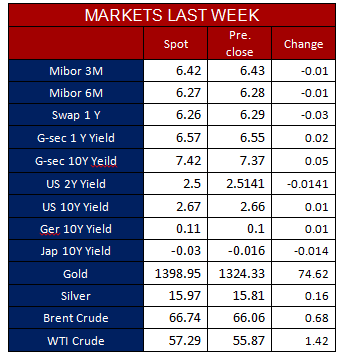
Markets traded unusually quiet last week amid geo political tensions and firm global cues as market participants were expecting a positive outcome from the US-China trade talks. The rupee traded between 70.9175 and 71.5150 versus the US Dollar. It ended just about 8 paisa higher at 71.44 as against 71.22 previous week’s close. Equity markets ended marginally higher recovering from initial losses. For the week BSE Sensex rose 0.17 percent or 62.53 points, to end at 35,871.48, while Nifty gained 0.62 percent, or 67.3 points, to close at 10,791.7. The foreign institutions investors (FIIs) has bought equities worth Rs 5,026.41 crore, while domestic institutions investors (DIIs) bought Rs 4,654.84 crore worth of equities in last week.
RBI FEB MPC MEETING MINUTES
The MPC of the RBI at its rate review held on Feb 5-7 considered a much bigger repo rate cut than the 25 bps cut that was delivered. Ravindran Dholakia, a member of the MPC stated that there was space for about 60 bps repo rate cut, as the central bank’s headline inflation forecast for the year ahead turned out to be less than the target of 4 per cent for the first time. “ Four members of the MPC voted for a rate cut, while two members, including Deputy Governor Viral V Acharya and member Chetan Ghate, voted for status quo.
The minutes showed Deputy Governor Viral Acharya suggested that the MPC should wait till the next policy for a rate cut. Mr. Acharya stated that the parameters gave greater comfort to cut the policy rate than at the present juncture.
He, however, voted for a change in the policy stance to neutral.
Ghate, who also voted for neutral stance, said the elevated level of inflation ex-food and fuel continued to be challenging, despite the fall from 5.8 per cent in November to 5.6 per cent in December. “Inflation has thus softened but not in a broad-based way,” he said. He said growth in a number of economies slowed in 2019 due to trade tensions and the associated uncertainty. This clouds India’s export outlook and should be carefully watched. He expressed worries about the fiscal consolidation and extra budgetary social spending programs of the government.
On the other hand, RBI Governor Shaktikanta Das, Michael Debabrata Patra, Ravindran H Dholakia and Pami Dua voted in favour of a rate cut.
FOREX RESERVES RISE BY $150 MN.
Forex reserves increased by USD 150 mn. to USD 398.272 bn. for the week to February 15 . The foreign currency assets increased by USD 88.9 mn. to USD 371.07 bn. for the reporting week. The value of the gold reserves increased USD 78.2 mn. to 22.764 bn.. The special drawing rights with the IMF also came down by USD 7.8 mn. to USD 1.455 bn.. Similarly, the country's reserve position with the Fund also declined by USD 9.1 mn. to USD 2.982 bn.
WEEK AHEAD
In the week ahead, the rupee is expected to be on the defensive due to the high crude oil prices. Uncertainty in the international markets will likely continue due to the US-China trade talks and the week being crucial for Brexit. Equity markets will be volatile due to F&O expiry this week.
On the economic front, the government will announce data on infrastructure output for January on 28 February 2019. The government will also announce data on fourth quarter gross domestic product (GDP) on 28 February 2019. The Indian economy advanced 7.1% year-on-year in the third quarter of 2018, well below 8.2% in the previous period. The Nikkei Manufacturing PMI (Purchasing Managers' Index) for February 2019 will be announced on 1 March 2019. The Nikkei India Manufacturing PMI increased to 53.9 in January 2019 from 53.2 in a month earlier.
HEDGING STRATEGY
For Importers: Hedge imports near or below 70.70 for Feb, March and April.
For Exports: Hedge Small amount exports near or above 71.50
INTERNATIONAL MARKETS
US Lackluster data releases continued last week with weakness in December durable goods orders and existing home sales number. But markets were holding on hopes of progress in US-China trade talks.
Various data releases pointed to soft momentum at the end of 2018 and in January 209. Durable goods orders were up 1.2% in December, but the underlying rise in non-defense capital goods orders ex-aircrafts declined 0.7%, the fourth such decline since August. The non-defense capital goods orders is an indicator of business-investment.
Housing market numbers continued to indicate its weak trend. Existing home sales declined 1.2% in January, hitting the lowest level since November 2015. The sales could have been down to the long government shut down since December third week. The lower demand could have also been due to high mortgage rates. However, mortgage rates have dropped more than 50 bps since late 2018. Due to this drop, Homebuilder confidence has improved in February, supporting a positive development.
The minutes of the January FOMC meeting showed members debated whether further rate hikes are necessary but appeared not contemplating cuts at the moment. FOMC continued to view sustained expansion in labour market conditions and inflation near 2% as the most likely path ahead. Some members expressed concerns about the slowing down in economic growth particularly in Europe and China. For now, the Fed might not hike rates and wait patiently to see if the US economy remains resilient in the face of global weakness.
By the end of last week, the trade talks were still under way. China had extended the trade talks giving some hopes to the markets. US President Trump will have to decide by next week if the March 1 tariff deadline should be extended. His comments suggest that he could extend the deadline, but the questions how far? He said there is a good chance a deal will be made and that he expects to meet with President Xi in the not-too-distant future. Although he also downplayed expectations by saying that they “perhaps could work out the final deal and perhaps not,” they are closer to an agreement than ever before. Trump even talked about a short-term memorandum of understanding (MOU). However “there are some great hurdles left” according to US trade representative Lighthizer.
In the week ahead, in the US, PCE Core inflation numbers for December are due to be released on Friday, expected to come in at 0.2% m/m and 1.9% y/y, which is just below the Fed’s 2% target. On Thursday, BEA is scheduled to release initial Q4 GDP, which will implicitly also give us the PCE inflation data for December. GDP growth is expected to come in at around 2% q/q annualised (3.0% y/y). On Friday, we get ISM manufacturing data for February. The survey still indicates that the manufacturing sector is expanding in general. The coming week also brings housing market numbers for December on Wednesday. Recently, the housing market has started to show a bit of weakness, especially home sales numbers, possibly driven by higher mortgage rates. However, housing market data are quite volatile and we will continue to keep an eye on the housing market. Jerome Powell is set to testify before the Senate Banking Panel on Wednesday and the House Financial Services Committee on Thursday.
EUR Eurozone data continue to be generally weak into the new year. Eurozone February Mfg. and Service sector PMIs hardly offered any positive picture of the economy. On the negative side, the manufacturing PMI fell to 49.2, the first time that index has been in contraction territory since mid-2013. That largely confirms softness seen in other indicators, including a large decline in December industrial production. On a more positive note the service PMI rose to 52.3, the first increase since September, meaning that the economy-wide composite PMI also rose in February. Germany’s economy has been weak in recent quarters, and the fall in the February IFO business confidence to 98.5 hints at continued subdued growth. Overall, with growth sluggish and several European Central Bank policymakers have been adopting a more dovish tone in recent speeches.
ECB policymakers took a gloomy view on the economy at their last policy meeting and discussed about giving banks more long term loans, as per the meeting minutes released on Thursday, last week. Due to continuing weakness in growth for the third straight quarter, policymakers are increasingly concerned that global uncertainty is derailing the Eurozone’s recovery. Although the ECB just ended a 2.6 trillion euro (£2.3 trillion) bond purchase scheme to stimulate growth, it is now preparing the ground for giving banks more multi-year, cheap loans to banks to ensure they keep credit flowing to the economy even during the slowdown. Policymakers at the January meeting said they wouldn't be rushed into a new TLTRO but asked ECB staff to start working on such a facility. With ECB board members Benoit Coeure and Peter Praet openly discussing a new TLTRO, the real question is under what terms the loans will be provided. Still, policymakers at the January meeting continued to argue that the dip is merely a slowdown and not the start of Europe's next recession. While they said 2019 growth forecasts would need to be cut, they left open the question whether the medium term outlook, key for ECB policy, would need to be changed.
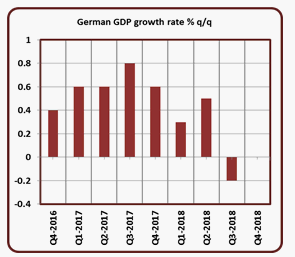
In the euro area, we are due to get the preliminary February HICP figures on Friday. These are an important piece of information for the ECB at its upcoming meeting on 7 March. In January, core
Inflation rose by 0.16pp to 1.09% y/y, while headline inflation decelerated to 1.4% y/y on the back of falling energy price inflation. With oil prices up some 30% since the trough in December, we expect headline inflation to rise slightly in February to 1.5%. Similarly, for core inflation, we see scope for a further small rise to 1.14% on the back of strengthening Phillips curve dynamics.
GBP: Sterling remained firmly anchored near 1.30$ level last week after labour data surprised on the upside and on hopes that no-deal Brexit could eventually be avoided. UK average weekly earnings including bonus grew 3.4% 3moy in December, unchanged from prior month and missed expectation of 3.5% 3moy. Weekly earnings excluding bonus rose 3.4% 3moy, up from 3.3% 3moy and matched expectations. Unemployment rate was unchanged at 4.0% staying at the lowest since 1970s. Also released, jobless claims rose 14.2k in January, above expectation of 12.3k. Claimant count rate was unchanged at 2.8%. The employment rose by 167,000 to a record high of 32.60 million in the three months to December. Economists were looking for an increase of 152,000. The employment rate remained at 75.8%, which was the highest since comparable records began in 1971.
However, the upside was limited and there was some selling seen on Friday as a Brexit break through at the Sharm El-Sheikh summit on Sunday. Prime Minister Theresa May is highly unlikely to bring back any revised deal for parliament approval next Wednesday.
It’s still uncertain whether UK Attorney General Geoffrey Cox could work out something with the EU to legally assure that Irish backstop would be temporary if triggered. If he can deliver something in the early part of this week, a revised Brexit deal would be put for another vote in the Commons on February 27. With Cox’s endorsement, it’s possible for PM May to get enough support. UK would then enter the final stage to prepare for an orderly Brexit.
If May couldn’t get anything new for another meaningful vote in the Commons, the parliament would then vote for amendments to take over control of Brexit. If May does not get a new deal or the House of Commons rejects the deal, there will be another indicative vote on Wednesday 27 February, which gives the members of parliament another chance to force Prime Minister May to ask for an extension of Article 50 to avoid a no-deal Brexit. UK politics on Brexit is now deeply divided. The chances are now 50:50 for a meaningful way forward.
There are not many economic data releases next week but look out for the PMI manufacturing index on Friday, which probably fell. Stockpiling due to Brexit preparations means the index is higher than the equivalent euro area index
JPY USD/JPY was mostly trading steady below 111.00 rates last week. USD/JPY was mostly trading higher on renewed optimism about the US-China trade talks throughout the week. However, the US 10Y T-Note which ended lower at 2.65% resulted in the USD/JPY remained caped.
Last week’s data release showed that Japan’s exports were under pressure. Japan’s merchandise trade deficit fell to 1,452.2 billion yen in January, missing forecasts for a deficit of 1,029.5 billion yen following the 56.7 billion yen deficit in December. Exports were down 8.4% y/y to 5.574 trillion yen, after dropping 3.9% in the previous month. Imports eased an annual 0.6% to 6.989 trillion yen versus expectations for a decline of 3.5% after rising 1.9% a month earlier. Also, Japan’s latest manufacturing PMI fell to a 32-month low at 48.5 in February, down from 50.3 in January. There was a strong decline in production and new orders.
Japan’s CPI was up by 0.2% YoY, below the previous 0.3%, while the core reading, excluding food and energy prices, ticked up to 0.4% from the previous 0.3%, The numbers were far below BOJ's desired level, despite the massive stimulus the central bank has been applying for years. In an interview with Asahi newspaper, Bank of Japan (BoJ) Governor Kuroda said that the BOJ would 'of course' mull additional easing if the economy were to lose momentum toward hitting the price goal.
In Japan, manufacturing PMIs have weakened significantly at the beginning of the year along with exports. It will be interesting to see whether industrial production confirms the current weakening picture with the January figures on Thursday. On Friday, we get another set of figures for the extremely tight labour market with the unemployment rate and jobs/applicants ratio for January.
CRUDE OIL: Oil prices rose on Friday, heading for a second weekly increase, driven up by optimism that the U.S. and China will forge a trade deal and that OPEC’s resolve to rebalance the market will outweigh soaring U.S. oil production. Prices of New York-traded West Texas Intermediate crude and London's Brent rose on Friday, heading for a third weekly gain in four. WTI settled up 30 cents, or 0.5%, at $57.26 per barrel. It hit a three-month high of $57.81 earlier. For the week, WTI was up about 2.3%, while Brent was around 1% higher.
Although gains are capped by data that U.S. crude oil production hit 12 million bpd and American crude exports hit a new record high last week, market participants are hopeful that the U.S. and China can bridge the gaps in their ongoing trade talks.
Crude prices were also supported somewhat by this week's drop in the U.S. oil rig count. The rig reading, published by industry firm Baker Hughes, showed drillers cut four rigs this week after raising them by 10 over two prior weeks. An early indicator of future output, the total rig count at 853 is still higher than the 799 rigs active at this time a year ago. Canada’s oil and gas rigs saw an even bigger decrease in the number rigs this week. Canada’s total oil and gas rig count fell by 12 rigs and is now 212, which is 94 fewer rigs than this time last year.
The path of least resistance in oil was certainly higher, although counteracting fundamentals were strongly building against the crude rally. Record crude exports out of America were saving the day for oil bears, data from the U.S. Energy Information Administration showed on Thursday, as domestic production hit the magic 12-million-barrels-per-day figure last week. The EIA forecasts that U.S. output will reach 13 million bpd by the end of 2020, the most that any country has ever achieved in daily production. But some analysts, including those at Citigroup (NYSE:C), believe that figure will be achieved this year.
The surge in U.S. production could offset OPEC cuts led by Saudi Arabia, warn oil bears who say that total supply is what will matter to the market despite American shale being a lighter variant oil of the heavier grade produced in the Middle East Another report by Standard Chartered Bank points out that one of the unexpectedly soft spots in global oil demand recently has been in Europe. Demand in Germany has fallen significantly. fell by 302,000 bpd in December compared to a year earlier. That was the tenth consecutive month of an annual decline in consumption in excess of 150,000 bpd. In November, Germany seemed to be the only source of fragility. But in December, the weakness popped up in many more European countries. According to Standard Chartered, in December, year-on-year declines in consumption were reported in France, UK, Netherlands and Italy. In November, Germany seemed to be the only source of fragility. But in December, the weakness popped up in many more European countries. It appears that the main threat of oil demand falling comes from Europe more than from China.